Click here to subscribe to our Bowles Law e-letter


Click here to subscribe to our Bowles Law e-letter
In April 2026, Cal/OSHA updated the “Safety and Health Protection on the Job” Notice to correct contact information for its Santa Barbara and San Francisco district offices without creating new workplace-safety rules.
In April 2026, Cal/OSHA updated the “Safety and Health Protection on the Job” Notice to correct contact information for its Santa Barbara and San Francisco district offices without creating new workplace-safety rules.
California employers must post required workplace notices in a conspicuous place at each physical establishment. Failure to meet Cal/OSHA posting requirements can result in civil penalties up to $12,471 per violation.
The updated Notice appears in CalChamber’s California and Federal Employment and Labor Law Poster.
Next Steps:
Take-Away:
Employers should display the updated Cal/OSHA poster or supplemental Notice at each workplace.
For further information, please contact Tim Bowles, Cindy Bamforth or Helena Kobrin.
See also:
Cindy Bamforth
August 5, 2026
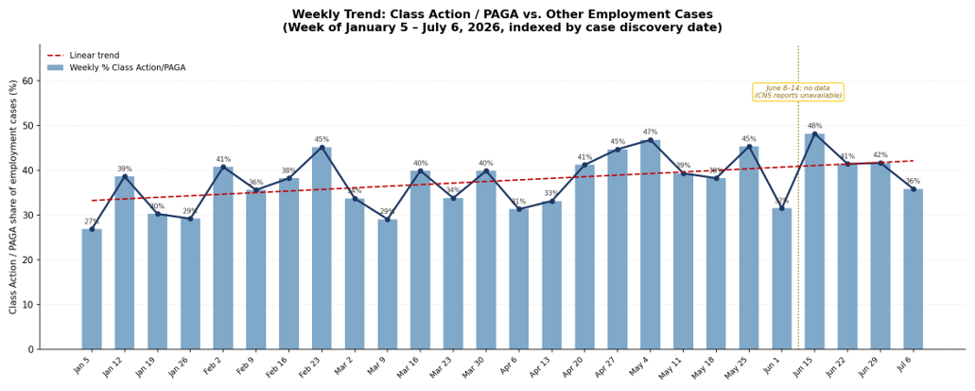
California’s employers are in the midst of a growing litigation epidemic, the wage-and-hour class action — a lawsuit built around one policy or practice applied to a company’s entire workforce, the exposure multiplied by every employee it touches and every pay period it covers.
California’s employers are in the midst of a growing litigation epidemic, the wage-and-hour class action — a lawsuit built around one policy or practice applied to a company’s entire workforce, the exposure multiplied by every employee it touches and every pay period it covers.
Class actions live and die on one question: is there a common policy or practice that affected a group of employees the same way? The lawyers aren't looking for one employee perhaps shorted some overtime. They're looking for a payroll rule, a scheduling practice, or a handbook provision that applied uniformly and thus permits a court to magnify a single violation to dozens, hundreds, or thousands of workers extending four years back from the date of filing.
The underlying facts are often mundane:
None of these individually would justify a major lawsuit. Yet, as they stem from a company-wide policy rather than an isolated manager's mistake, like the virtually certain speeding ticket if one drives long enough, it’s only a matter of time before that business may be tagged with a class case.
This state offers a special boost to this unpleasantness. Routinely, plaintiffs' firms add a PAGA (Private Attorneys General Act) layer to the class claims. See, e.g., PAGA Monster Declawed --Major Relief for Responsible Employers (June 28, 2024)
Take-Aways:
For further information, please contact Tim Bowles, Cindy Bamforth or Helena Kobrin.
See also:
Tim Bowles
July 31, 2026

On July 13, the Internal Revenue Service increased the optional standard business mileage rate from 72.5 cents to 76 cents per mile, retroactive to July 1, 2026.
On July 13, the Internal Revenue Service increased the optional standard business mileage rate from 72.5 cents to 76 cents per mile, retroactive to July 1, 2026.
The new rate applies to business use of personal vehicles, including gasoline, diesel, hybrid, and fully electric models.
California Labor Code section 2802 requires employers to reimburse employees for necessary business expenses, including required business use of a personal vehicle. While the IRS rate is not mandatory, it remains a simple and reasonable reimbursement method.
Take-Away:
Employers using the IRS standard mileage rate should reimburse at 76 cents per mile for business travel on or after July 1, 2026. They should also review July reimbursements paid at 72.5 cents per mile and issue a 3.5-cent-per-mile adjustment where applicable.
For further information, please contact Tim Bowles, Cindy Bamforth or Helena Kobrin.
See also:
Cindy Bamforth
July 29, 2026
The U.S. Department of Labor’s Wage and Hour Division recovered $30,442 in back wages from the University of Tennessee for violating a staff member’s leave rights and for failing to provide its workforce with leave policy. The employee was on intermittent (i.e., non-continuous) leave under the Family and Medical Leave Act when the university demanded resignation or be terminated.
The U.S. Department of Labor’s Wage and Hour Divisionrecovered $30,442 in back wages from the University of Tennessee for violating a staff member’s leave rights and for failing to provide its workforce with leave policy. The employee was on intermittent (i.e., non-continuous) leave under the Family and Medical Leave Act when the university demanded resignation or be terminated.
Companies with 50 or more employees within a 75-mile radius, as well as public agencies and local educational institutions, are required to provide FMLA leave. For those who have worked 1250 hours in the preceding 12 months, this is protected leave of up to 12 weeks per year for:
California employers need only have five or more on payroll to be covered by the comparable California Family Rights Act. Employees also must have worked 1250 hours in the preceding 12 months to be eligible for up to 12 weeks leave for their own serious health conditions, care of an expanded list of family members or designated person with a blood or family-like relationship with a serious health condition, adoption and foster child or birth-related care.
Other FMLA and CFRA requirements management must learn to manage leaves correctly include:
Take-Aways:
Management must know their employees’ leave rights, provide posters and any other notifications of those rights, and allow workers to take all protected leave.
For further information, please contact Tim Bowles, Cindy Bamforth or Helena Kobrin.
See also:
Helena Kobrin
July 24, 2026
The U.S. Department of Labor’s Wage and Hour Division recovered $1,730,598 in back wages for 1,666 workers after finding that The State Group Industrial (USA) Ltd. Inc., a Tennessee-based multi-trade contractor, miscalculated overtime by excluding incentive bonuses from the employees’ regular rates of pay.
The U.S. Department of Labor’s Wage and Hour Division recovered $1,730,598 in back wages for 1,666 workers after finding that The State Group Industrial (USA) Ltd. Inc., a Tennessee-based multi-trade contractor, miscalculated overtime by excluding incentive bonuses from the employees’ regular rates of pay.
Under federal law, overtime generally must be paid at 1.5 times the employee’s “regular rate,” not merely 1.5 times the base hourly rate. The regular rate generally includes all compensation for the workweek, subject to statutory exclusions. The calculation is:
Total includable compensation for the workweek (excluding overtime and statutory exclusions) ÷ Total hours worked that week = Regular Rate
DOL Fact Sheet 56A explains what to include or exclude from the federal regular rate. Discretionary bonuses may be excluded, but State Group failed to include non-discretionary incentive bonuses in its regular rate calculation.
Wage and Hour Division Administrator Andrew Rogers stated:
"The State Group violated federal law when it excluded bonuses from its overtime calculations, averaging more than $1,000 in back wages owed to each employee. Our investigators remain committed to obtaining appropriate remedies for workers who are not paid as the law requires and driving long term compliance to prevent violations in the future."
California law also requires overtime based on the employee’s regular rate of pay. Under Labor Code section 510, overtime is generally due at 1.5 times the regular rate, with double time required in specific circumstances. See Calculating Overtime with Employee Bonuses in California.
Flat-sum bonuses -- guaranteed dollar amounts for specific actions like weekend work -- have special overtime rules. Under federal law, divide the flat sum bonus by total hours worked that week to calculate overtime. In California, divide the flat sum bonus by the non-overtime hours actually worked (capped at 8/day or 40/week), not total hours worked. This can produce a higher overtime rate. California employers are required to pay whichever is the higher amount.
Take-Aways:
Employers must calculate and pay overtime based on the correct regular rate. Using the base hourly rate alone can create substantial liability.
For further information, please contact Tim Bowles, Cindy Bamforth or Helena Kobrin.
See also:
Helena Kobrin
July 17, 2026

California law generally requires employers to provide non-exempt employees with a timely, uninterrupted 30-minute meal period when they work more than five hours in a day
California law generally requires employers to provide non-exempt employees with a timely, uninterrupted 30-minute meal period when they work more than five hours in a day. Employers need not force employees to take meal breaks, but they must be ready to explain meal break exceptions, i.e., missed, short, or late meal records. Two California Supreme Court decisions, Brinker and Donohue, explain why.
Brinker: Provide the Break
Brinker requires employers to relieve non-exempt employees of all work duties and provide a genuine opportunity for a timely, uninterrupted meal period -- not police breaks or force employees to eat.
Donohue: Document Exceptions
Donohue addresses meal break exceptions: the law presumes a violation unless the employer proves it provided a proper meal break opportunity or the employee voluntarily skipped or shortened it.
The Court also barred rounding meal break times because rounding can hide late or short breaks.
Employers should document the reason for each exception before payroll closes. If the employer caused the problem or cannot document a voluntary employee choice, it should pay the meal period premium: one additional hour at the employee’s regular rate of pay.
The Practical Difference
Brinker gives employers flexibility; Donohue requires proof when records show a problem. Meal break records often drive PAGA and class action claims because plaintiffs look for patterns: late lunches, missing meal records, short breaks, automatic 30-minute lunch deductions, or unpaid premiums.
Take-Aways
Employers should:
Employers that provide proper breaks and document exceptions reduce the risk that one meal break issue becomes a broader PAGA or class action claim.
For further information, please contact Tim Bowles, Cindy Bamforth, or Helena Kobrin.
See also:
Cindy Bamforth
July 16, 2026

Wage-and-hour compliance is not a bookkeeping problem, it is a litigation problem. Labor Code standards are mandatory, a dense, technical, penalty-laden web covering timekeeping, minimum wage, pay stubs and much more.
Wage-and-hour compliance is not a bookkeeping problem, it is a litigation problem. Labor Code standards are mandatory, a dense, technical, penalty-laden web covering timekeeping, minimum wage, pay stubs and much more. A disgruntled former employee is just a Google search away from the growing community of worker-side lawyers specializing in bringing class action torment down on even a modestly sized business.
For instance, Young’s Nail Spa, employing 36 persons in Temecula, settled for $1.2M on alleged independent contractor misclassification, underpayment of overtime and failing to provide appropriate meal and rest breaks.
Lin’s Fusion, a Fresno restaurant employing 32, agreed to pay $2M to resolve allegations of unpaid overtime, deprived meal periods and undocumented cash wage payments.
This is simple multiplication math, one or more seemingly small errors spread over all workers employed up to four years back. Pick your industry: hospitality, retail, manufacturing, healthcare, construction, beauty services. The facts change. The pattern does not.
Take-Away:
Review workplace practices for compliance with experienced legal counsel and promptly fix what you find. For instance, the worst time to discover your timekeeping system is noncompliant is after a “knock on the door” from the law firm that feeds off such shortcomings.
For further information, please contact Tim Bowles, Cindy Bamforth or Helena Kobrin.
See also:
Heed the Plague Workplace Mass Litigation Is Out of Control (January 30, 2026)
Devils or Detail - Precision Timekeeping: Protection Against Business Damnation (Jan. 2, 2026)
Paystub Purgatory - The PAGA Perils of Not Paying Attention (March 14, 2025)
Tim Bowles
July 10, 2026
.jpg)
Management must combine all of an employee’s daily and weekly hours worked at all locations and pay any resulting overtime.
The federal Department of Labor has flunkedFirst Physical & Functional Rehab for failing to count the employees’ cumulative hours at three work locations, thus shorting them on overtime pay.
First Physical settled with the DOL for $171,897 back wages and $18,810 civil penalties for willful violations.
An employer may not separately treat a worker’s labors at different locations to avoid paying overtime even where, as here, each venue is separately incorporated. First Physical’s website shows each of its three offices as a joint enterprise.
Honolulu Wage and Hour Division Acting District Director Patrick Candoleta said: “Employers must abide by federal laws and ensure that workers are fully compensated for all hours worked. We will continue to hold employers accountable to help ensure that compliance is a priority in every workplace. We will also offer compliance assistance to help employers who seek it avoid violations of overtime requirements and other wage and hour rules.”
Take-Aways:
Management must combine all of an employee’s daily and weekly hours worked at all locations and pay any resulting overtime.
For further information, please contact Tim Bowles, Cindy Bamforth or Helena Kobrin.
See also:
Helena Kobrin
July 3, 2026
.jpg)
Do not assume HSI will treat minor I-9 mistakes as technical defects with an opportunity to fix them. When receiving a Notice of Inspection, employers have only three business days to provide requested I-9s, so HR should proactively audit I-9s, review remote onboarding, confirm electronic systems comply, and train staff. Employers unsure about compliance should consult employment or immigration counsel.
On March 16, 2026, U.S. Immigration and Customs Enforcement released an updated Form I-9 inspection fact sheet, classifying many I-9 errors as substantive violations. This distinction is important: technical or procedural failures usually allow at least 10 business days for correction, but substantive violations may result in a Notice of Intent to Fine without that opportunity.
What Changed:
The statutory framework remains the same, but the practical risk has changed. ICE now classifies more errors as substantive violations. Employer-side commentators call this a significant reclassification of errors previously seen as clerical or correctable.
Errors ICE Now Identifies as Substantive:
The fact sheet lists several substantive violations: failure to prepare or present Form I-9, late completion of Sections 1 or 2, use of the Spanish-language I-9 outside Puerto Rico, missing employee details in Section 1, incomplete List A, B, or C documentation, missing employer representative details in Section 2, missing preparer or translator information when required, and incomplete reverification or rehire information in Supplement B.
ICE also considers it a substantive violation to omit the alternative-procedure box when using an authorized method or to use the method without meeting E-Verify or DHS requirements.
Penalties and Retention:
Current penalties for I-9 paperwork violations range from $288 to $2,861 per violation, adjusted annually. ICE calculates penalties based on the number of substantive and uncorrected technical violations, then adjusts by up to 25% based on business size, good faith, seriousness, unauthorized worker involvement, and prior violations.
Employers must retain Form I-9 for each current employee and, for former employees, for at least three years after hire or one year after employment ends, whichever is later. As best practice, employers should keep I-9s and any retained supporting documents in a separate I-9 file or system, not in individual personnel files.
Take-Aways:
Do not assume HSI will treat minor I-9 mistakes as technical defects with an opportunity to fix them. When receiving a Notice of Inspection, employers have only three business days to provide requested I-9s, so HR should proactively audit I-9s, review remote onboarding, confirm electronic systems comply, and train staff. Employers unsure about compliance should consult employment or immigration counsel.
For further information, please contact Tim Bowles, Cindy Bamforth, or Helena Kobrin.
See also:
Cindy Bamforth
June 19, 2026